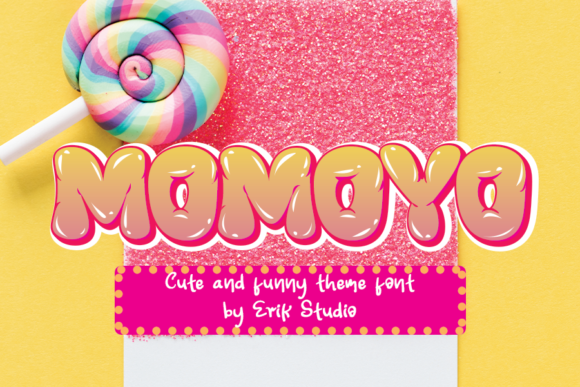
Momoyo Display Font for Handmade Brands & Craft Projects
As someone who designs printable wall art, hand-labels my small-batch candles, and cuts custom vinyl decals for local boutiques, I’ve learned that the right display font isn’t just decorative—it’s a quiet salesperson. Momoyo is one of those rare fonts that feels like it was made *for* crafters: clean enough to read at 12pt on a sticker, quirky enough to stand out in a crowded Etsy shop, and warm enough to make customers pause mid-scroll.
Visually, Momoyo sits beautifully between friendly and polished. It’s not overly cutesy—no exaggerated loops or cartoonish proportions—but it has subtle personality: slightly rounded terminals, gentle contrast in stroke weight, and an open, airy rhythm that keeps even short phrases feeling breezy and intentional. Think of it as the typeface equivalent of a hand-poured soy candle with a linen label—not fussy, but unmistakably thoughtful.
I reach for Momoyo most often when clarity and charm need to coexist. That means it shines on physical product labels (like my lavender-scented soap bars), where legibility matters at 3/8” height on a curved bottle, and the font still reads cleanly through my Cricut’s fine-cut blade. It works equally well on 4” round stickers for farmers’ market jars—its balanced x-height and generous counters prevent ink fill-in during printing, and its consistent spacing avoids awkward gaps when cutting vinyl.
For wedding stationery, Momoyo adds sincerity without formality. I used it for “Welcome to Our Day” on a rustic wooden welcome board last spring—and guests kept commenting on how “inviting” it felt. No sharp serifs, no stiff geometry—just approachable elegance. On digital printables like planner covers or habit trackers, it gives structure without rigidity. Its lowercase “a” and “g” have just enough character to feel handmade, while uppercase letters hold strong in headings and titles.
Seasonal craft projects are where Momoyo really flexes its versatility. Last December, I paired it with a minimalist sans serif for holiday mug wrap designs—Momoyo handled “Joy,” “Cozy,” and “Gather” with warmth, while the companion font carried ingredients and care instructions cleanly. For Easter egg labels, I used Momoyo’s lightest weight in soft pastel pink on kraft paper—soft but legible, joyful but not childish. And yes, it holds up on fabric transfers: I tested it on cotton tote bags using heat-transfer vinyl, and the curves stayed crisp even after two washes.
Readability is where many cute display fonts falter—but Momoyo’s design prioritizes function. At sizes above 16pt, it’s effortlessly scannable on social media banners and Instagram story highlights. At 10–14pt, it stays clear on printed invitation suites (especially when paired with quality 300gsm cardstock). Just avoid setting full paragraphs in Momoyo—it’s a display font, not a text face. Save it for names, headlines, taglines, and short decorative phrases where impact matters more than volume.
Pairing Momoyo thoughtfully makes all the difference. My go-to combo is Momoyo + a neutral, humanist sans serif like Montserrat or Poppins for body text, product descriptions, or ingredient lists. For contrast-rich SVG files (think layered quote art for Cricut or Silhouette users), I layer Momoyo over a delicate handwritten script—say, for “You Are Loved” posters—using the script for emphasis and Momoyo for grounding balance. If you’re building a brand identity system, Momoyo also pairs surprisingly well with a refined serif like Playfair Display for formal elements like certificates or boutique packaging.
The Momoyo family includes standard OpenType features—ligatures, stylistic alternates, and multilingual support covering Western European languages. That means your French bakery labels (“Pain au Chocolat”) or bilingual baby shower invites (“Bienvenue / Welcome”) render correctly without manual glyph swaps. Files come in OTF and WOFF formats, so you can use them across design apps, web templates, and cutting machine software without conversion hiccups.
One practical note every maker should know: Momoyo is licensed for commercial use. That means you can use it confidently in client work, sell physical products with Momoyo-based designs (like mugs, t-shirts, or greeting cards), bundle it into Canva templates, embed it in SVG cut files for digital download shops, or include it in printable planners sold on Etsy or Gumroad. Just double-check the license terms for redistribution rights if you’re bundling fonts directly into editable design files—but for standard crafting and product creation? You’re covered.
What sets Momoyo apart isn’t just how it looks—it’s how it *works*. It scales reliably from 8pt product tags to 72pt wall art. It converts cleanly to vector paths in Illustrator and Inkscape. It previews accurately in mockup generators, so what you see in your design file matches what prints on kraft sticker sheets or etches onto wood signs. And because it’s not overly ornate, it doesn’t demand extra design time—no kerning gymnastics, no glyph hunting, no “why won’t this cut right?” moments.
Whether you’re labeling artisanal honey jars, designing a boho-chic wedding suite, updating your Shopify banner, or creating a printable “Grateful” journal page for Thanksgiving, Momoyo brings cohesion without compromise. It’s the kind of display font that makes your handmade brand feel both intentional and easy—like the best craft supplies always do.